
DeSoto Projected and Actual Dates
A projected date is a current calculation, not a record of an event that has already happened. For an active Florida prisoner, FDC labels the public estimate Current Release Date. The label matters. It is not a scheduled pickup time, a promise of parole, or the date for a person held only at the DeSoto County Jail. Once a state prisoner leaves FDC custody, Inmate Release Information can show the actual release date and release type.
County custody follows another path. A pretrial detainee may leave after bond, recognizance, dismissal, a release order, or a transfer, but there may be no sentence-based date to calculate. A person serving a county sentence has a date computed from the commitment, jail credit, and applicable rules. DCSO jail/booking or the sentence-computation record is the authoritative route. The court docket explains the legal order, while the DCSO Released record confirms when the booking moved to released status.
| Record | What it means | Where to check |
|---|---|---|
| Current Release Date | FDC's public projection for an active state prisoner | FDC Inmate Population record |
| Actual release date/type | A completed FDC custody event and its stated category | FDC Inmate Release Information |
| County sentence date | DCSO computation based on the commitment and jail credit | DCSO jail/booking or a records request |
| Pretrial status | No fixed sentence date; bond and court action govern | DeSoto docket and DCSO custody records |
Run a DeSoto Release Date Lookup
Start with the custody system. FDC covers people sentenced to Florida state prison or state supervision. It does not become the record system for a person serving only a county-jail sentence. Conversely, a DCSO release followed by an active FDC prison record points to a custodial transfer, not a return to the street. The DeSoto County released-inmate search brings the agency, court, and destination checks together when custody is uncertain.
- Identify the agency. Use DCSO for a local jail stay and FDC for a Florida prison sentence. Use the court case to resolve an unclear commitment.
- For a state prisoner, open the FDC Inmate Population search. Search the six-character DC number or name and compare aliases, descriptors, offense data, and photograph.
- Read the field labeled Current Release Date. Record the date and when the search was checked. Do not relabel it as guaranteed or actual.
- For a former prisoner, switch to Inmate Release Information and read the actual release date, type, and any supervision history.
- For a DeSoto County Jail sentence, contact jail/booking or request the sentence-computation and release sheet. Compare it with the commitment and jail-credit entries in the Clerk docket.
- If a hold, detainer, or new commitment appears, search the destination agency before describing the event as community release.
The official FDC active-inmate form is the route to the Current Release Date on a matched prison record.
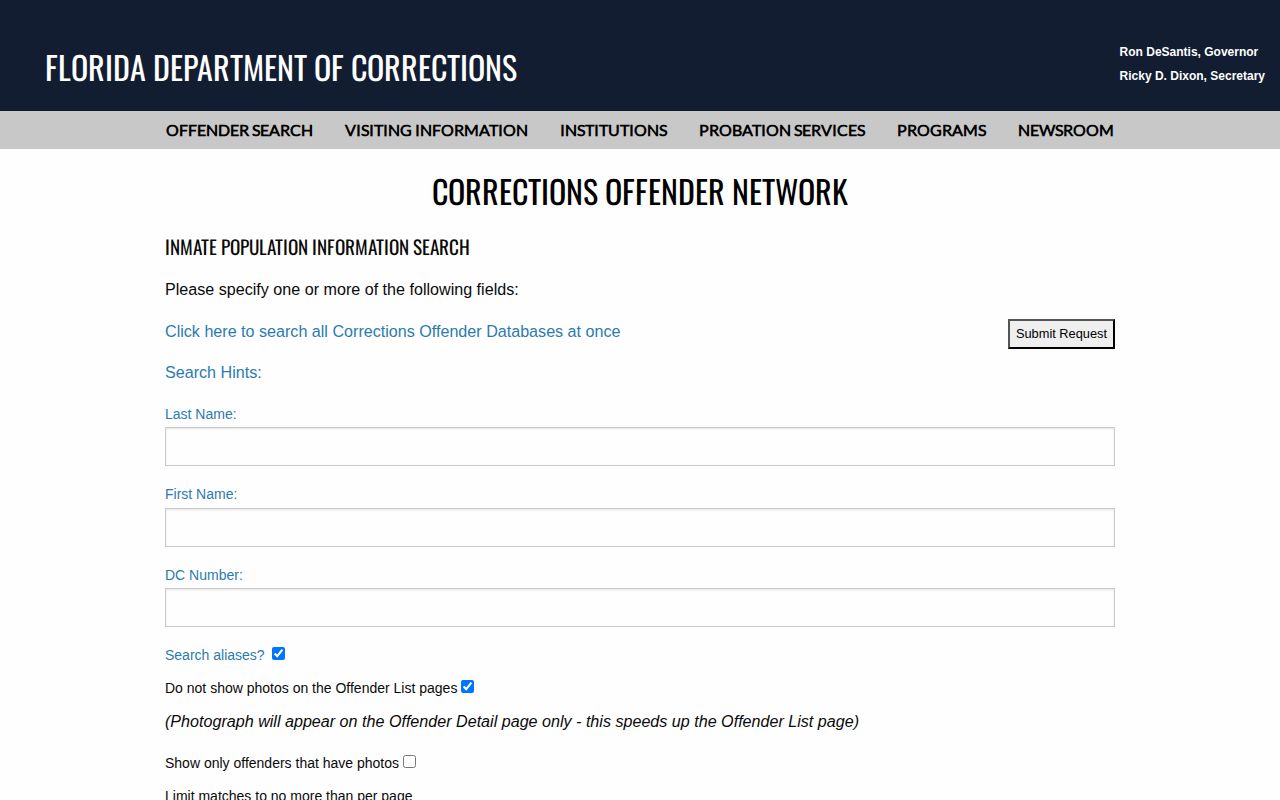
The search screen is only the first step. Open the matched profile and preserve FDC's exact field label and status.
Note: FDC updates active-inmate release-date and location changes nightly, though the complete population database refresh occurs weekly.
FDC DeSoto Release Date Fields
The FDC search separates current inmates, released inmates, supervised offenders, absconders, fugitives, and other categories. That design prevents a common mistake: seeing one state record and assuming it answers every custody question. Search All can locate a possible match, but the specialized database shows the fuller set of release or supervision fields.
A matched profile can include DC number, committed name and aliases, physical identifiers, photograph, current location or status, incarceration history, sentence and offense data, release information, and community-supervision history. The dedicated release database contains information and photographs for inmates already released or scheduled for release, and FDC says it is updated nightly. Name searches work as prefixes, and the interface permits alias searching. Compare the DC number and sentence history before using any date.
The official FDC release-field explanation defines the information available through the state release database.
These definitions help distinguish a present estimate from a historical release event and its recorded type.
Florida Gain-Time for DeSoto Releases
Florida Statutes section 944.275 authorizes gain-time and sets offense-date-specific rules. For qualifying offenses committed on or after October 1, 1995, incentive gain-time cannot reduce actual service below 85 percent of the sentence imposed. The often used 85-percent phrase is a statutory floor. It is not a promise that every prisoner receives a flat 15-percent reduction.
FDC applies the rules to the sentence structure, eligibility, credit, forfeiture, and legal history. Mandatory minimums, excluded offenses, disciplinary loss, multiple or consecutive sentences, jail credit, and later court orders can change the result. Earlier statutory periods have different basic and incentive gain-time rules. Older parole-eligible cases may also depend on Chapter 947 and FCOR action. A hand calculation from the sentence length can therefore be wrong even when the arithmetic seems simple.
The official Florida gain-time statute shows the minimum-service and credit framework.
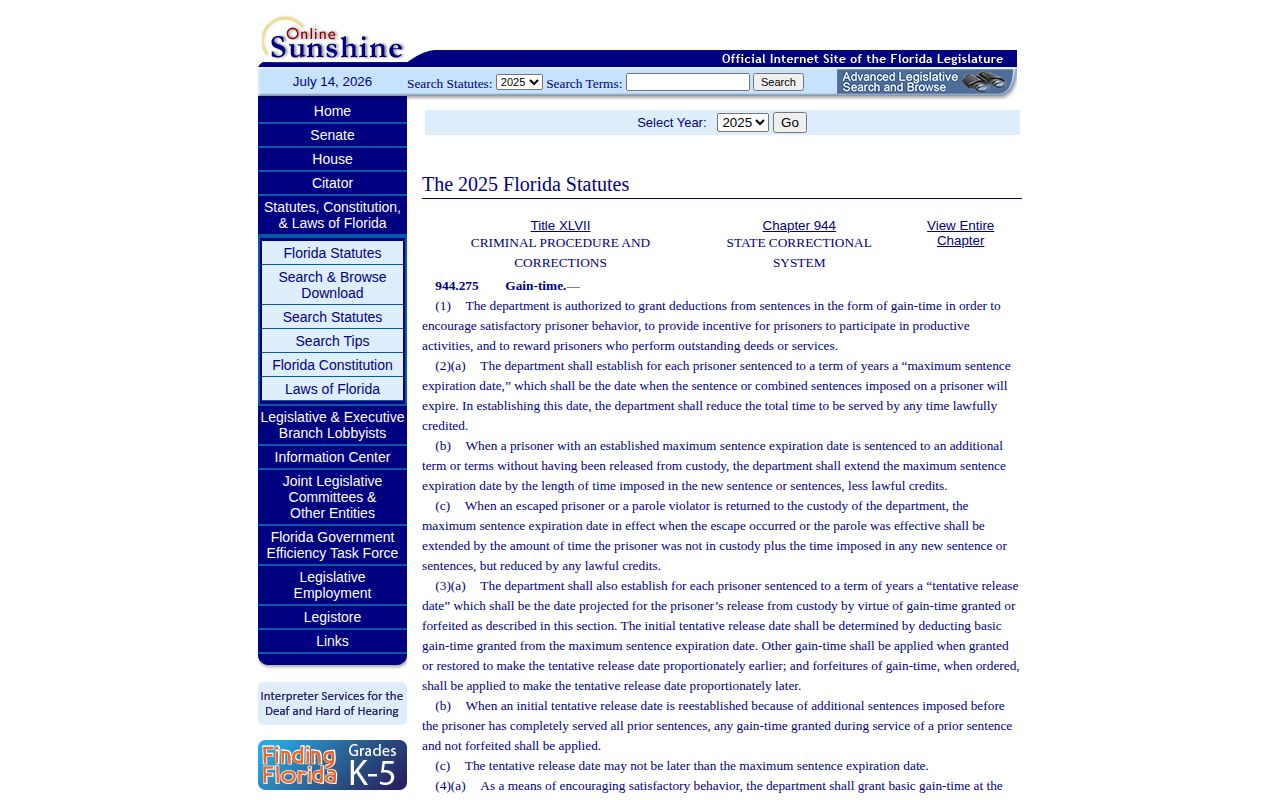
The public FDC date remains the better working estimate because the agency applies these rules to the actual sentence record.
Section 921.002 supplies Florida's Criminal Punishment Code sentence framework, while section 944.275 addresses gain-time. These laws do different work. The sentence imposed by the court establishes the term and structure; FDC then calculates the prison release projection with applicable credit and gain-time rules. For an older parole-eligible case, FCOR action under Chapter 947 can add another decision layer. Reading only one statute or one docket line will not recreate the full agency calculation.
Note: The 85-percent rule concerns qualifying state-prison sentences and must not be applied automatically to a DeSoto County jail term.
Why DeSoto Release Dates Change
A later, blank, or revised Current Release Date does not by itself prove misconduct. Lawful adjustments can occur when FDC receives new court records, recalculates credit, applies gain-time rules, or resolves another sentence or hold. Ask for the sentence or release calculation when the reason must be established rather than inferred.
| Change factor | Possible effect | Best proof |
|---|---|---|
| Corrected or amended sentence | Moves the controlling term or credit | Court order and FDC calculation |
| Prior-custody or jail credit | May move the computed date earlier or later after correction | Judgment, credit order, and classification record |
| Gain-time award, withholding, loss, or restoration | Changes the estimated state-prison service period | FDC sentence/release calculation |
| Concurrent or consecutive sentence | Changes which term controls and how terms interact | Judgments and FDC sentence history |
| Detainer or hold | May cause transfer to another authority at the end of FDC or DCSO custody | Agency record and destination locator |
| Commission or court action | Can establish, modify, suspend, or rescind a release date | Final FCOR action or court order |
Conditional-release calculations also can affect the public date or the legal status after prison. A presumptive parole release date is a Commission planning or decision date for an eligible case, not proof of physical release. Always check the FDC released record after the expected event.
DeSoto County Jail Date Computation
DCSO computes a county jail sentence from the commitment or order and the jail credit recognized under applicable law and local practice. No official DeSoto source identifies a public county good-time calculator. The research also found no county rule promising early release because a date falls on a weekend or holiday. Applying the state-prison 85-percent shorthand to the local sentence would be unsupported.
Call DCSO jail/booking at 863-993-4700 or 863-993-4710, option 4, extension 2630, when a county date is time-sensitive. For a durable record, ask for the sentence-computation or release sheet and identify the person, booking number, and date range. The DeSoto Clerk docket can supply the judgment, sentence, credit entry, or later order, but the Clerk does not certify the jail's physical release time.
A bond amount also is not a release date. Posting cash or surety bond through the jail lobby begins processing. DCSO says release times vary, so a paid bond or signed order should be followed by the Released record or direct jail confirmation.
A focused Chapter 119 request can ask for the existing commitment, sentence-computation record, jail-credit record, actual release date and time, public release type, and transfer destination if releasable. Ask for electronic copies and an estimate. Florida does not impose one universal response deadline, and extensive work can support a charge based on actual labor. The request should seek records that DCSO keeps, not ask the agency to produce a new forecast or legal opinion.
Confirm a DeSoto Release Event
A date check ends with the agency that carried out the event. For FDC, open Inmate Release Information and read the actual release date and exact release type. Then inspect the supervised-population record because release from prison may lead directly to conditional release, parole, probation, or another status. A destination FDC institution means transfer, not release.
For DCSO, use the official Released database and compare the admit date, release date, time in jail, charge or court type, and arresting agency. The DeSoto docket supplies the legal reason. If a just-issued order has not appeared, DCSO says physical processing takes time; call jail/booking instead of assuming the web entry is immediate.
Florida VINE can add an event alert but is not a permanent release ledger. The DeSoto County VINE inmate check explains how to match one record and register. Confirm any alert in DCSO or FDC. When FDC's public calculation needs an authoritative explanation, the Bureau of Admission and Release publishes 850-488-9167 and dc.release@fdc.myflorida.com.
For an archival FDC question, request existing release, sentence, incarceration, and classification records through the agency's public-records channel and provide the DC number. Central Records publishes 850-488-9859 and central.classification@fdc.myflorida.com for classification or record questions. A records response can explain the calculation more fully than a screenshot, though protected medical, security, victim, and other information remains exempt.