
DeSoto County Parole and Probation
Parole and probation can both place a person in the community under rules, but they arise in different ways. The Florida Department of Corrections, or FDC, supervises felony probation, community control, parole, conditional release, and several other statutory forms of supervision. The Florida Commission on Offender Review, or FCOR, makes parole and certain release decisions. A court orders probation. FCOR controls parole decisions for those who are eligible, while FDC carries out field supervision.
Florida parole mainly concerns older parole-eligible offenses. The state abolished parole for most crimes committed on or after October 1, 1983, with statutory exceptions and special categories. Many modern prison records therefore show a Current Release Date, conditional release, or a later probation term rather than a parole date. Chapter 947 supplies the governing parole framework. The exact offense date, sentence, and release authority matter more than a loose use of the word parole.
| Status | How it starts | Public verification route |
|---|---|---|
| Parole | FCOR action for a parole-eligible case | FDC Supervised Population, then FCOR records when the final action is needed |
| Felony probation | A criminal court sentence or order | FDC Supervised Population and the sentencing docket |
| Conditional release | A statutory post-prison release status | FDC release and supervision history |
| County probation | A county-level court order | The DeSoto Clerk docket and the office named in the order |
- Discharge
- The formal end of a custody or supervision term.
- Community control
- A strict form of community supervision that can include limits on movement.
- Absconder
- A supervised person whom FDC reports has stopped making himself or herself available for supervision.
- Conditional release
- Post-prison supervision imposed under Florida law for qualifying cases.
Check DeSoto County Supervision Status
The official starting point is the FDC Supervised Population search. It covers FDC supervision, not every county-only probation order. Search by DC number when possible. Otherwise, use the legal name and compare the record's identifying details, offense or case data, supervision type, dates, and office information. A name match by itself is weak proof.
The correct sequence separates release from discharge. A former prison record may show an actual release, while a second FDC record shows active community supervision. A DCSO Released entry proves that the listed county booking left Sheriff's custody. It does not place every released person on FDC supervision. The DeSoto County released-inmate search path supplies the jail and court checks that establish the event before supervision is assessed.
- Identify whether the person left DCSO custody, FDC prison custody, or another system. Keep the releasing agency attached to the result.
- Open FDC Supervised Population and search the six-character DC number or the person's legal name. Review aliases where the search permits them.
- Match the result with the DC number, offense and sentence history, supervision type, status, dates, and listed office. Do not rely on a photo alone.
- Read the DeSoto Clerk docket when the sentence may be probation or community control. A county probation order may have no FDC match.
- Use the public office directory to confirm the current public-facing office. Assignments can change, so avoid relying on an old staff name.
The official FDC supervision portal is shown below. Its specialized database avoids mixing a person under supervision with an inmate who is still in prison.
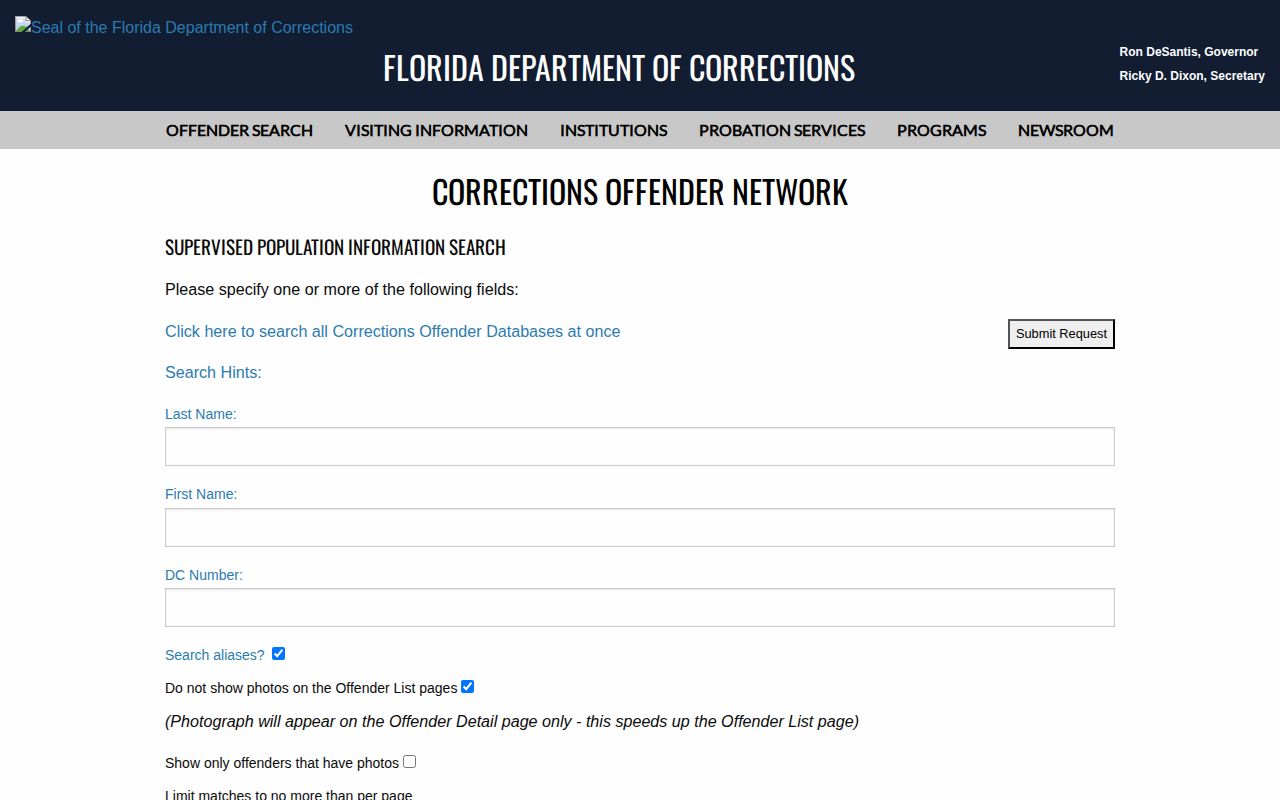
The record still needs a court or release-record cross-check when the type, dates, or county connection are unclear.
Note: FDC updates supervision termination dates and location changes nightly, while the full supervised database is refreshed weekly.
DeSoto County Supervision Office
FDC publishes a dedicated Arcadia location within its Sarasota Circuit. Office 122 serves as a local public contact for a person whose FDC record points to that office. The circuit covers DeSoto, Manatee, and Sarasota counties. An office listing is not proof that any named person reports there. Search the supervision record first, then call with the DC number to ask whether the public record still identifies the right office.
FDC Office 122, Arcadia
301 N. Brevard Avenue, Suite F
Arcadia, FL 34266-4550
Phone: 863-993-4631
Fax: 863-993-4652
The FDC Sarasota Circuit directory also lists the circuit headquarters at 1870 17th Street, Sarasota, Florida, with 941-554-5921. Ask for public office confirmation, not protected case plans, treatment facts, or risk information.
The official Arcadia Office 122 listing gives the local address and circuit coverage.
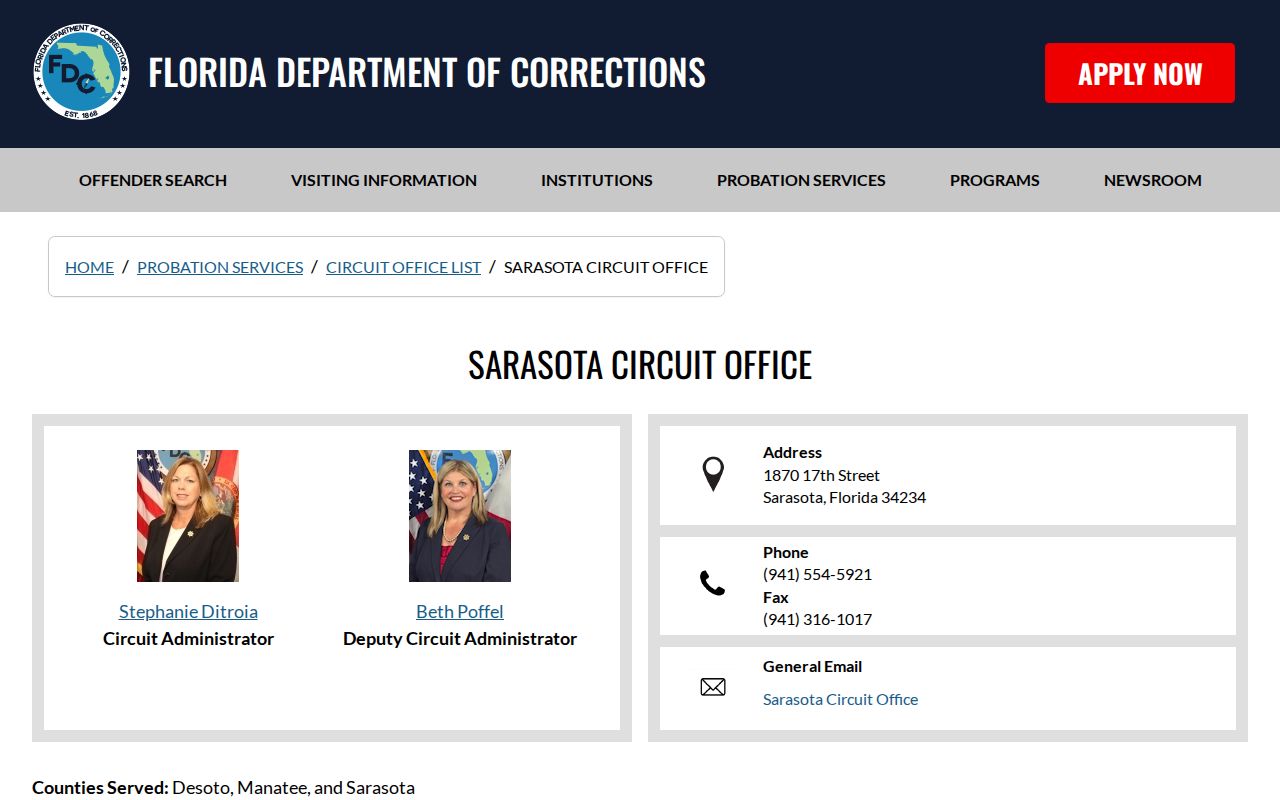
This directory is the current public source to recheck before a visit or call because reporting assignments can move.
DeSoto County Absconder Checks
An absconder result is not the same as a new conviction or proof of present jail custody. FDC uses the term for a supervised person who ceased making himself or herself available. The result signals an active supervision issue and possible warrant. It should be verified through the statewide record and the issuing court or agency. DCSO wanted-person material does not replace this statewide supervision check.
Use the FDC Absconder search, compare the DC number and case details, and then check DCSO Current or another likely jail locator if present custody matters. The statewide Absconder Unit publishes 850-717-3475 for weekday calls from 8 a.m. to 5 p.m. Section 947.22 provides arrest-warrant authority for parole and related Commission releases, but a page hit alone does not show where the person is now.
The official FDC absconder form is a separate database from the ordinary supervision search.
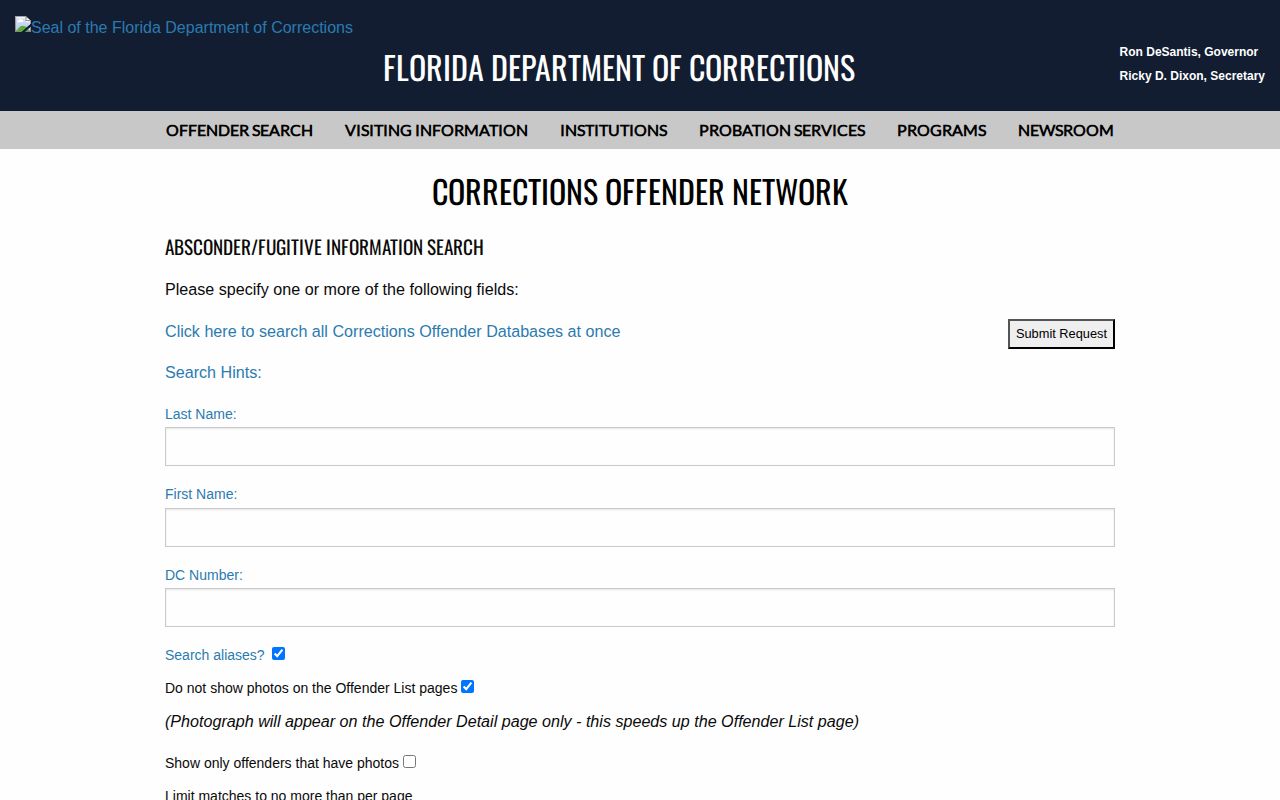
A match should lead to an agency and court check, not a claim that the person has committed a new crime.
DeSoto County Supervision Terms
Conditions come from the judgment, release order, statute, and supervising authority. Public records may show the broad supervision type, start and end dates, reporting office, offense or case, and whether the status is active, terminated, or absconded. They do not make all case-management details public. The court docket is the sound source for the terms stated in a DeSoto County judgment or later violation order.
A reported violation can lead to an investigation, warrant, hearing, change in conditions, revocation, or no final adverse action. Those steps are not interchangeable. Read the final docket entry or Commission action before describing the outcome. FCOR's calendar is a schedule of matters, not a person-name results database. When a final parole or conditional-release action is needed, request the order through FCOR Public Records.
Florida VINE may send certain community-supervision events, including absconding, return or capture, supervision changes, and death, when the supplying agency participates. That alert is useful for notice, but it is not the final court or Commission record. Capture the event type and agency, then check FDC and the issuing authority. Direct VINELink registration also is separate from FDC Victim Services, so changing contact details in one system does not update the other.
Note: A supervision record shows legal status, while the court or Commission order supplies the authority and final outcome.
Property After a DeSoto Release
Post-release needs can begin before supervision reporting. DCSO says property may be picked up before release through a Property Release Form, and identification is required for the person collecting it. Property not collected usually leaves with the released person. If an item remains, DCSO describes notice, claim, abandonment, and disposal procedures under section 705.103.
A commissary order that arrives after release follows a different local rule. DCSO gives the released person 30 days to retrieve it before donation. These jail procedures do not establish an FDC reporting date or pause a supervision duty. A person leaving DCSO custody who also has an FDC term should follow the reporting direction in the release or court paperwork and handle property through the jail's published process.
DeSoto County Supervision Discharge
Release from incarceration and discharge from supervision are separate milestones. Active supervision can continue after a person leaves the DeSoto County Jail or an FDC institution. Discharge means the supervision term has formally ended. The FDC record's termination information, a court order, or an FCOR action should support that conclusion. A projected end date should not be treated as completed supervision before the agency record changes.
If FDC shows no result, first test spelling, aliases, and the DC number. Then determine whether the sentence was county probation, which FDC says lies outside its search coverage. The DeSoto Clerk docket and the office named in the sentencing order are the right fallback. A negative state search does not prove that all supervision ended.
For an FDC discrepancy, Field Services publishes 850-717-3444 and co-supervision@fdc.myflorida.com. Provide the DC number and ask about the public status or correction route. The office cannot disclose protected information merely because a caller knows the person's name.
A discharge also does not erase the underlying judgment or prove that an unrelated case, warrant, registry duty, or civil order ended. Keep each record within its scope. The supervision termination answers the FDC or court-supervision question; a separate agency must answer its own status.