
DeSoto Prison Release Paths
DeSoto Correctional Institution, the Annex, and the Work Camp form a state prison complex operated by the Florida Department of Corrections. A person who leaves one part for another FDC institution is still incarcerated. The same is true of a movement from the Work Camp to the Annex or from the Annex to another prison. A changed location is not an actual release unless the FDC record also supplies release information that ends confinement.
A state prison departure can occur at sentence expiration, through an authorized form of post-prison release, or under another FDC release type. The public record may then show active conditional release, parole, probation, community control, or another form of community supervision. Release from prison and discharge from supervision are separate milestones. A released person may be in the community yet remain under an enforceable supervision order.
| FDC result | Custody meaning | Next check |
|---|---|---|
| DeSoto Annex or another FDC location | State confinement continues | Inmate Population detail |
| Actual release date and release type | Prison custody ended | Inmate Release Information Detail |
| Active supervision record | Outside prison, under supervision | Supervised Population record and listed office |
| Projected Current Release Date | Estimated future date | Active profile and FDC release staff |
| Transfer to secure civil commitment | Criminal term ended, confinement continues | Civil court and applicable registry |
Confirm a DeSoto Prison Release
Use the FDC Offender Search, not the DCSO Current or Released roster. The statewide system separates active prison population, inmate release information, supervised population, and absconder or fugitive records. Search All is useful at first, but a specialized database exposes the fields that best answer the release question.
- Search by the six-character DC number when known. Otherwise enter first and last name and consider the aliases option.
- Compare the DC number, committed name, aliases, physical identifiers, photograph, offense data, and sentence history. Do not match on name or image alone.
- For a former state prisoner, open Inmate Release Information and read the actual release date and exact release type.
- Inspect incarceration history to distinguish DeSoto-to-prison movement from release. Then review community-supervision history.
- Record when the profile was checked. Contact the correct FDC records unit when a very recent event or disputed field needs confirmation.
The assigned manifest image below comes from the FDC Inmate Release search. Its release-specific database is the right first view for a past prison discharge.
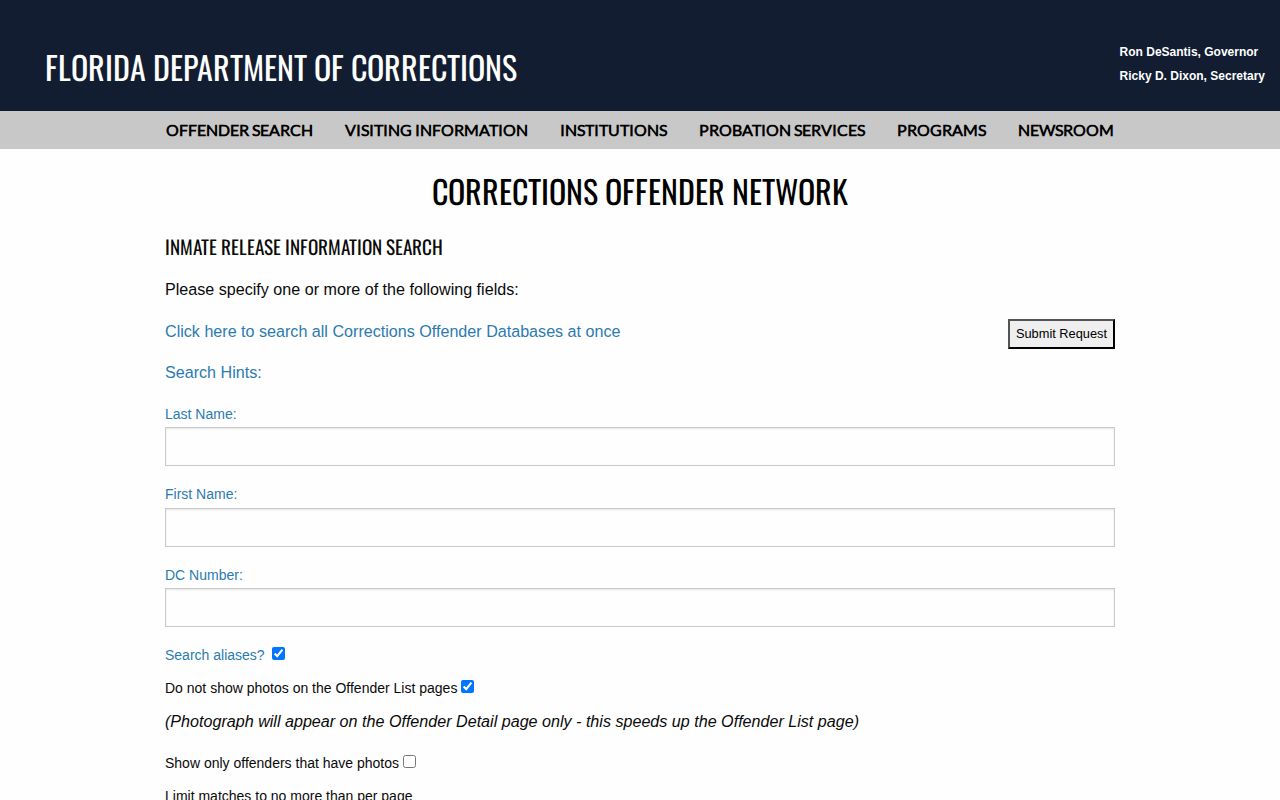
FDC says this database includes people released or scheduled for release and is updated nightly, so an event from the same day may not appear at once.
DeSoto Prison Release Fields
An FDC profile can show the DC number, name and aliases, physical description, photograph, current status or location, incarceration history, sentence and offense data, release information, and community-supervision history. Each part answers a different question. Status and location show whether the person remains in state prison. Inmate Release Information Detail supplies the historical event. Supervision history shows whether legal control continued after the prison gate.
Use the exact FDC release type. Do not replace it with a broad label such as parole unless the record says parole. Florida parole mainly concerns older parole-eligible cases and specific statutory exceptions. Many current sentences end through expiration or another release framework. For a person still confined, the displayed Current Release Date is a projection. It is not an actual event date or pickup time.
- Release date
- The actual historical date in release detail after confinement ends.
- Release type
- FDC's stated legal or administrative category for the departure.
- Current Release Date
- The operative estimate on an active prison record, subject to change.
- Supervision history
- The record of community control after release, including status and dates where public.
The FDC system refreshes release-date and location changes nightly, while full active-population data is refreshed on a broader cycle. A same-day discrepancy is not proof that either the court or prison failed to act. Save the DC number and ask the responsible FDC bureau to verify or correct the public field.
Note: The broader DeSoto County release search distinguishes county jail, state prison, federal, immigration, and civil records when the prior custodian is unclear.
DeSoto Prison Projected Release
The Current Release Date on an active FDC record is the best public projection for a state prisoner. It is calculated from controlling sentences, jail or prison credit, gain-time eligibility, forfeiture or restoration, and other legal constraints. The date can move after an amended sentence, new concurrent or consecutive term, disciplinary action, detainer review, conditional-release calculation, or court or commission action. A blank or later date does not prove misconduct.
Florida's gain-time law is often reduced to an 85-percent phrase, but section 944.275 is more exact. For qualifying offenses committed on or after the statutory date, incentive gain-time cannot reduce service below 85 percent of the imposed sentence. That is a floor, not a promise of a flat 15-percent credit. Offense dates, mandatory minimums, ineligible offenses, multiple sentences, credit, and forfeitures can change the result.
The assigned active-inmate capture comes from the FDC Inmate Population search, where the projected field belongs.
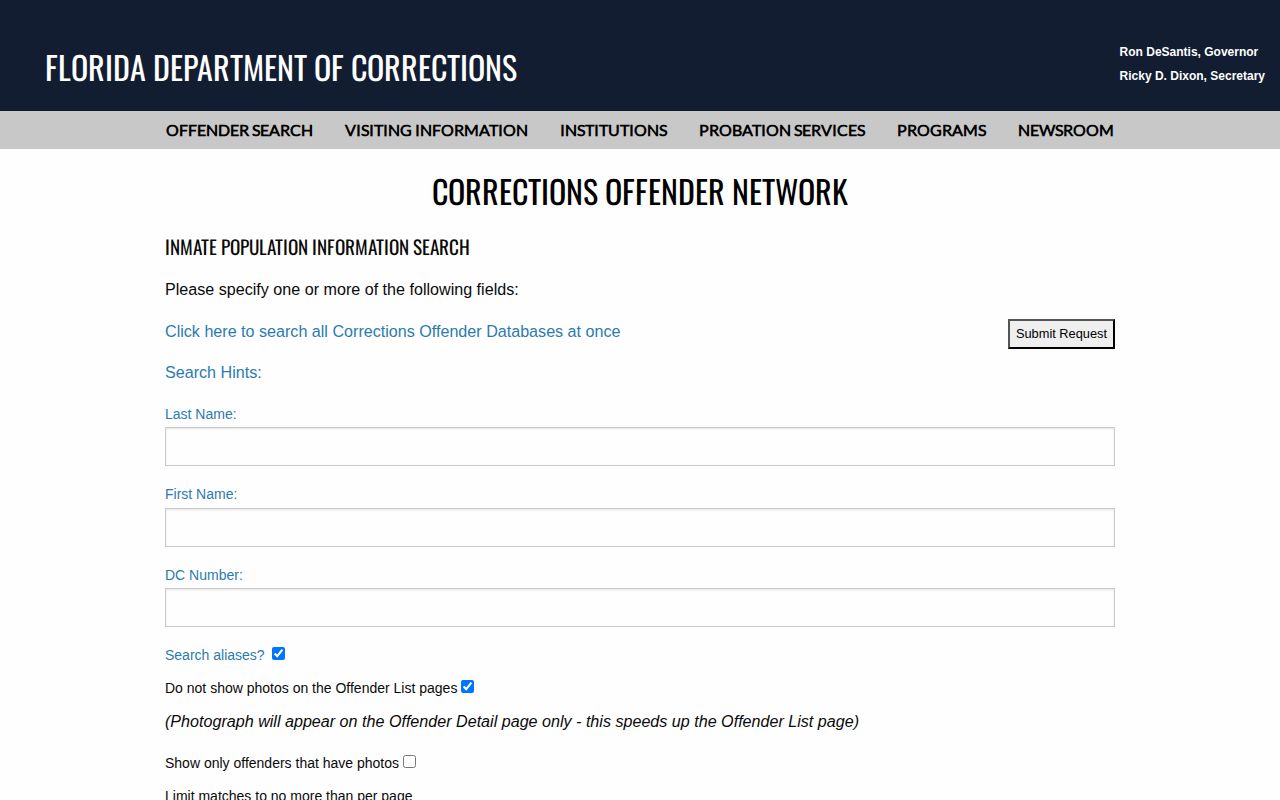
Read the date with an as-of time and never treat it as a fixed exit hour. The dedicated DeSoto County Release Date Lookup addresses date changes and sentence computation in more depth.
DeSoto Prison Release Records
FDC divides questions by subject. The Bureau of Admission and Release handles release-date information. Central Records handles classification and record questions, while Field Services addresses public community-supervision information. Provide the DC number and identify the exact field or existing record that needs review. Do not ask an institution to treat a question as a request for a newly created analysis.
DeSoto Correctional Institution / Annex
Florida Department of Corrections
13617 S.E. Highway 70
Arcadia, FL 34266
Includes the DeSoto Work Camp satellite
FDC Release and Records
Admission and Release: 850-488-9167
dc.release@fdc.myflorida.com
Central Records: 850-488-9859
central.classification@fdc.myflorida.com
A formal request goes through the FDC public-records process. Ask for existing release, discharge, incarceration-history, or sentence-calculation records and releasable portions. The agency may review and redact medical, mental-health, victim, security, and other protected information under Florida law. An estimate may apply for a broad request.
The official DeSoto Annex directory entry is the source for the complex name, Arcadia location, and Work Camp relationship shown in this assigned image.
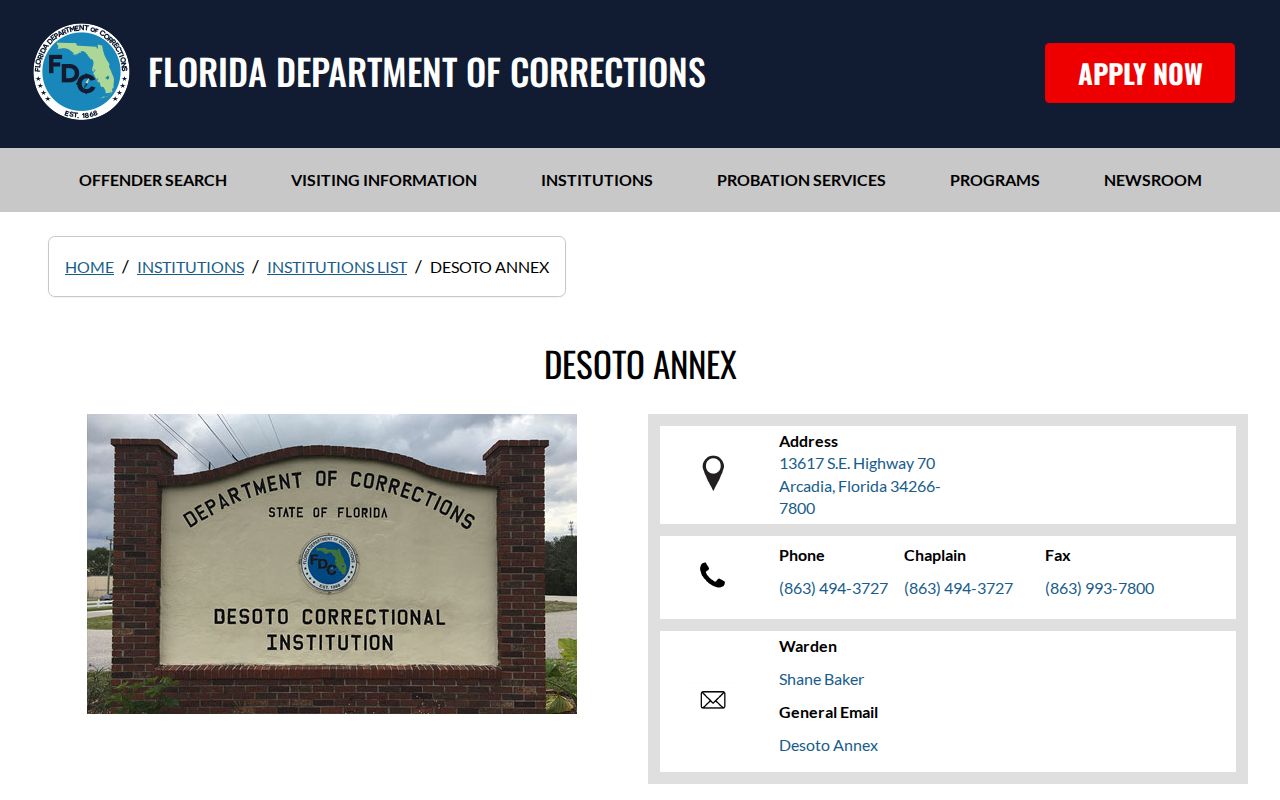
The institution listing identifies the site. The statewide offender and release databases still control the public status lookup.
DeSoto Prison Supervision Check
After an actual prison release appears, search FDC's Supervised Population database with the same DC number. Public fields may show the supervision type, status, dates, offense or case information, and office information. An active result confirms that prison confinement ended while legal supervision continues. It does not mean the person remains inside DeSoto Correctional Institution.
Use the listed or serving FDC probation office to confirm public reporting-office information. DeSoto County has an Arcadia office in the Sarasota Circuit, but not every person leaving the prison complex will report there. Assignments can follow the approved release address and can change. FDC Field Services lists 850-717-3444 and co-supervision@fdc.myflorida.com for public supervision questions. If the record instead identifies an absconder, that means the person stopped making themselves available for supervision. It may signal a warrant, but it does not prove current confinement or a new conviction.
DeSoto Release Into Civil Commitment
DeSoto County is especially prone to a difficult status mismatch. A person can complete an FDC prison sentence and then enter the Florida Civil Commitment Center in Arcadia under the Jimmy Ryce Act process. FDC may correctly record the person as released from criminal incarceration. That does not mean the person entered the community. Secure civil custody can begin as the prison term ends.
Confirm the next status through the civil-commitment court and, where applicable, the FDLE sexual-offender registry. Treatment records are confidential and are not a public release database. A later community or conditional release from FCCC requires judicial action in the civil matter. Keep the prison release date attached to FDC, and keep the civil custody or release decision attached to the court.
About DeSoto Correctional Institution
The Arcadia complex is part of the statewide FDC system. The Annex and Work Camp names matter because an internal movement can look like a facility departure without ending custody. When a profile changes from the Work Camp to the Annex, or from DeSoto to another institution, use the location and incarceration history as evidence of transfer. Reserve release language for an actual FDC release event.
An FDC offender photograph is a state corrections image and may not be the same as an earlier county booking photograph. It can help compare identity alongside the DC number and physical data, but it should never be the sole match. Names, aliases, sentence history, and release detail provide the stronger record trail.
Note: A prison discharge can end confinement while supervision continues, and a transfer between DeSoto complex units ends neither custody nor sentence.