
FCCC Judicial Release Paths
The Florida Department of Children and Families oversees the Sexually Violent Predator Program, and a contractor operates the secure treatment center in Arcadia. FCCC holds civil residents, not a county jail population. Some are awaiting trial on whether civil commitment is required. Others have been committed under the Jimmy Ryce Act after a court process. Their custody basis is a civil order, even when the path into FCCC began as a Florida prison sentence ended.
A later departure to the community depends on judicial action in the civil case. The outcome may be an unconditional release or a conditional release governed by terms set through the legal process. A change in DCF placement or treatment level is not enough to prove a community release. The court order is the central record because it identifies the action and its legal effect. Where the person is subject to registration, the FDLE registry can provide a second public check of status.
| Event | What it means | Controlling check |
|---|---|---|
| FDC prison release into FCCC | Criminal confinement ended, secure civil confinement began | FDC release detail plus civil court record |
| Continued FCCC residence | Civil commitment or pretrial civil custody continues | Civil case and lawful public status source |
| Conditional release | Community placement may occur under a court-ordered plan | Current judicial order and registry status if applicable |
| Unconditional judicial release | Civil commitment ends under court authority | Final release order |
| Registry status change | Limited registration or supervision information | FDLE record, read with the court order |
Confirm an FCCC Judicial Release
There is no researched public FCCC release roster comparable to DCSO Released or FDC Inmate Release Information. The sound route begins with the civil proceeding. Search the court record using the known case details, identify the order that governs current placement, and distinguish a court schedule from a signed disposition. A prison release date can help establish the transfer timeline, but it cannot settle the civil status.
- Confirm that the person was associated with FCCC, not merely released from a DeSoto County jail or an FDC institution.
- Identify the civil-commitment case and review the docket for a commitment, conditional-release, revocation, placement, or final release order.
- Obtain the actual order when its wording matters. A docket label alone may not state every condition or effective date.
- Search the FDLE Sexual Offenders and Predators system if registration applies, and read the displayed status precisely.
- Compare dates and agency scope. Use the court for judicial action, FDC for the prior criminal discharge, and FDLE for registry status.
The assigned manifest capture below comes from the DeSoto criminal court portal. That portal is useful for DeSoto case research, but the correct civil-commitment court and case must be identified from the actual proceeding rather than assumed from the facility's Arcadia location.
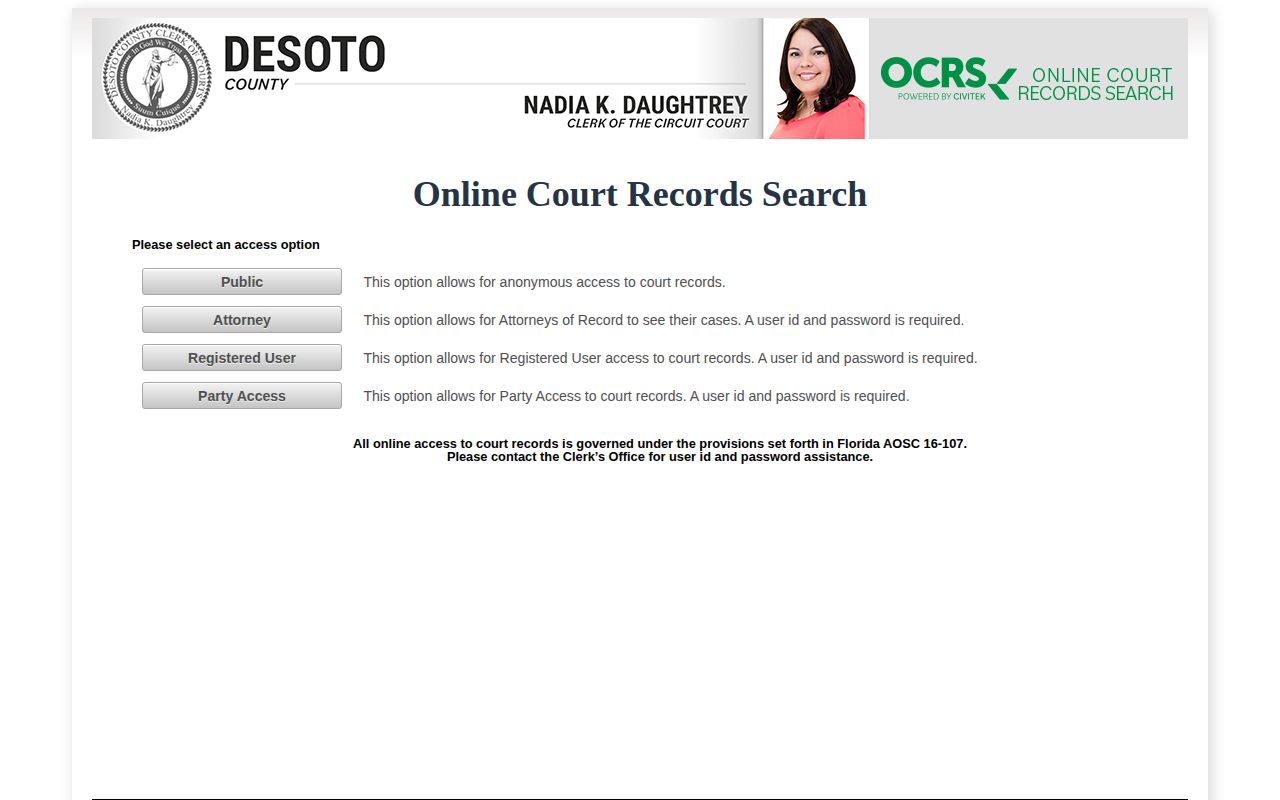
Portal results are indexes to court activity. A certified copy of the signed order provides stronger proof when exact legal status matters.
FCCC Release Is a Separate Event
FCCC creates a distinctive DeSoto County custody boundary. Someone can reach the end of an FDC prison term and enter secure civil commitment without spending a day free in the community. The FDC profile may truthfully show an actual release date and type for criminal incarceration. The civil court record may also truthfully show that confinement continues under a different source of authority. Neither record should be stretched beyond its agency and legal scope.
This is why the phrase “released from prison” cannot be turned into “released to the community” for a person sent to FCCC. Use a two-event timeline: FDC criminal release, then FCCC civil admission or continued commitment. A later judicial release from FCCC is a third event. Each should have its own date and source. That method preserves the key distinction between the end of a sentence and the end of secure civil confinement.
A DCSO released entry can present a similar issue if a local booking ends through transfer to treatment or commitment. It proves that sheriff custody ended, not that all custody ended. The DeSoto County release-record search follows these system boundaries when the releasing agency or destination is uncertain.
Note: Never infer community release from a roster disappearance, a prison discharge date, or a facility move without the civil court's action.
FCCC Release Registry Check
The FDLE Sexual Offenders and Predators Search is a narrow post-custody source for people legally required to register. Its status options can distinguish civil commitment, confinement, FDC supervision, release subject to registration, absconded status, deportation, and other listed categories. Registry presence does not prove present confinement. It often continues after release because registration and custody are different legal concepts.
Use the record as corroboration, not as a replacement for the civil order. A status such as “Released, Subject to Registration” has a specific registry meaning. It does not serve as a general summary of every condition imposed by the court. Likewise, a civil-commitment label supports the fact of that status but does not disclose confidential treatment facts or predict when a court may act.
The assigned image was captured from the official FDLE registry search named in the manifest.
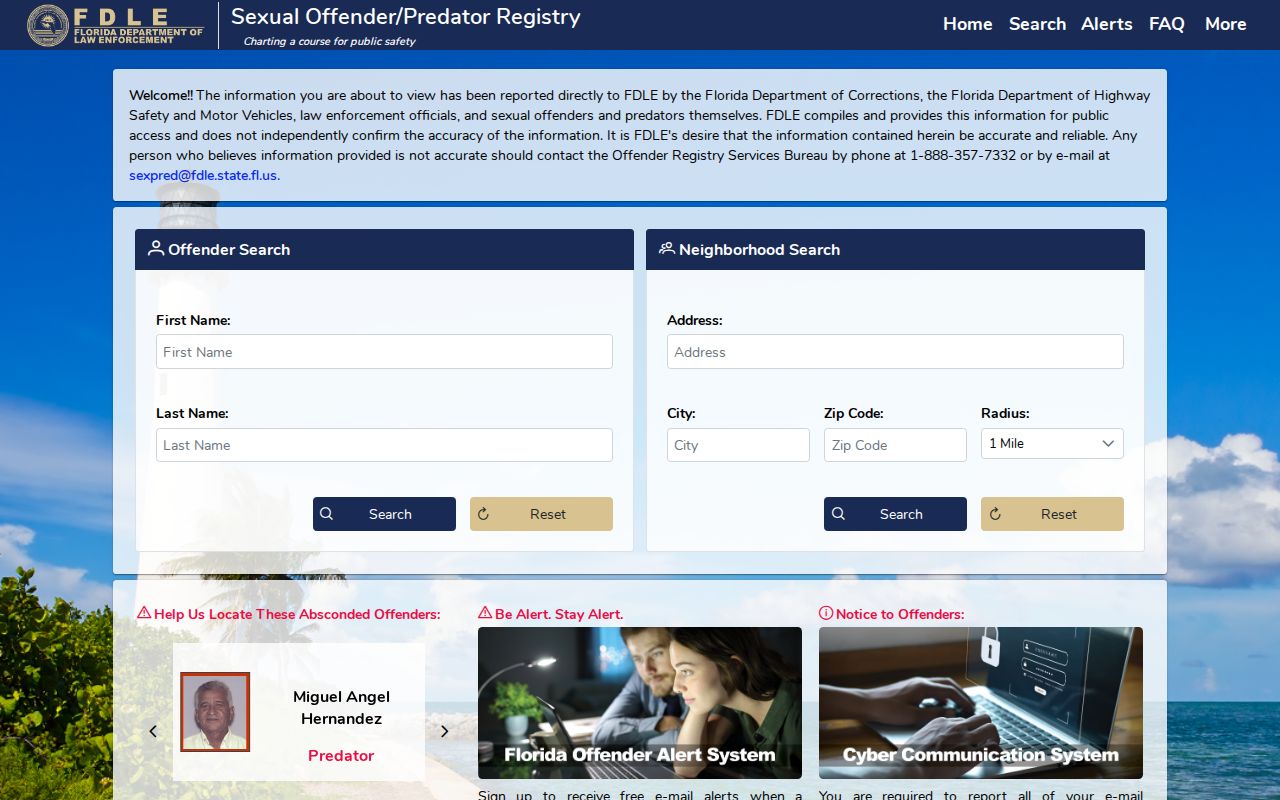
The registry's identity fields, photo, reported address, and status can help compare the right person, but the judicial order remains the proof of FCCC release.
FCCC Judicial Release Records
Request the signed judicial document from the clerk that holds the civil-commitment case. Specify the case number, party name, approximate order date, and the type of record, such as a conditional-release order, revocation, placement order, or final release order. Ask for certification when an authenticated court copy is needed. Do not ask DCF clinical staff to produce a public custody history from confidential treatment records.
The DeSoto Clerk can assist with DeSoto County court records and can help determine whether a local docket is held there, but facility location does not by itself establish venue for every civil-commitment matter. The proceeding and order control which clerk is custodian. If the DeSoto court is the right source, use the published records contact below.
Florida Civil Commitment Center
DCF Sexually Violent Predator Program
Secure contracted treatment facility
Arcadia, Florida
Public release proof: civil court order
DeSoto County Clerk
115 E. Oak Street, Room 101
Arcadia, FL 34266
863-993-4876
Monday through Friday, 8:30 a.m. to 4:30 p.m.
Closed noon to 1 p.m.
Public access has limits. Clinical, medical, mental-health, juvenile, victim, and other confidential information may be protected. A focused request for an existing court order is different from a request for treatment details. It also avoids asking a clerk or agency to create a new summary that it does not maintain.
FCCC Release Record Roles
Three public systems may appear in one timeline, and each has a narrow role. FDC documents the end of criminal prison custody. The civil court documents commitment, continued confinement, conditional release, or final release. FDLE documents registration status for a person covered by that law. DCF explains the program and oversees the secure treatment system, but confidential clinical material is not the public means of proving release.
- FDC release detail
- Shows when and how Florida prison custody ended.
- Civil court order
- Shows whether secure civil commitment continues or judicial release was granted.
- FDLE registry
- Shows a limited public registration and status record where the law applies.
- DCF program source
- Explains FCCC's civil treatment role, not a person-level public release list.
A strong status statement attributes every fact: released by FDC on the listed criminal date, then held at FCCC under civil authority, then conditionally or finally released by the named court if an order supports that last step. Avoid compressing all three into one broad release date.
About FCCC Civil Commitment
FCCC is one of three different secure settings that shape release research in DeSoto County. DeSoto County Jail is a local sheriff facility. DeSoto Correctional Institution is a state prison complex. FCCC is a secure civil treatment facility. Their public records do not overlap neatly, and none of the three systems can answer every question about the others.
Use respectful, accurate terms. People held at FCCC are residents in a civil commitment program. The facility is not a county jail, and its residents should not be placed in a criminal jail roster category. Civil commitment follows its own judicial framework. Accuracy depends on naming the current authority, reading the actual order, and separating confinement from registration or supervision.
Note: Treatment progress and clinical records are not public release tools; rely on the civil court and applicable public registry instead.