
DeSoto County Release Records
A DeSoto County release entry records that one agency ended a specific custody event. It does not always mean the person walked free. The DeSoto County Sheriff's Office, or DCSO, may mark a jail booking released after bond, a court order, time served, sentence completion, or transfer. Florida Department of Corrections records use different terms for a prison discharge. Federal and civil systems keep their own records. The agency named on the record sets the scope of what that release proves.
That distinction matters in DeSoto County. The county holds a local jail, a large state prison complex, and the Florida Civil Commitment Center. A person may leave one of them and enter another secure setting. The sound check uses the releasing agency's record, the court order or docket, and the next system when a transfer or supervision is possible. Absence from a current roster is only a clue.
- Discharge
- The end of a stated custody or supervision term.
- Time served
- A sentence resolved with credit for time already spent in custody.
- Detainer
- A request from another authority to hold or transfer a person.
- Expunction
- A court-ordered process that sharply restricts public access to an eligible record.
DeSoto County Release Types
The legal event should come from the DCSO detail, the DeSoto Clerk docket, a court order, or a records response. Do not infer a reason from the date alone. The same “Released” label can cover several very different paths.
| Release type | Meaning | Next check |
|---|---|---|
| Cash or surety bond | Bond was posted and the jail completed release processing. | DCSO Released detail and court docket |
| Recognizance or pretrial release | A court allowed release under stated terms without a completed sentence. | Court order and later docket events |
| Dismissal or no-file action | The listed case ended or prosecutors did not file it as shown in the record. | Clerk disposition |
| Time served or sentence completion | The custodial term ended after credit and sentence calculation. | Release sheet and judgment |
| Probation or other supervision | Custody ended, but legal supervision may remain active. | FDC supervised search or sentencing order |
| Transfer or detainer | The DCSO booking ended while another agency took custody. | FDC, BOP, ICE, receiving jail, or civil court |
Note: A DCSO release status confirms the booking ended, while the court record explains the legal basis and any terms that continue.
DeSoto Release Record Fields
The official DCSO Released grid gives more than a name. Its visible columns connect the custody stay to an admit date, a release date, and a calculated time in jail. Optional columns add the primary charge, court type, and arresting agency. Opening a name supplies booking-level detail. Those fields establish that the listed booking changed to released status in the sheriff's system, but they do not decide guilt or rule out a transfer.
| Field | What it shows |
|---|---|
| Full name | The name attached to the DCSO booking record |
| Age, race, and sex | Displayed identifiers used to avoid a wrong-name match |
| Admit date | When the listed jail stay began |
| Release date | When DCSO marked that booking released |
| Time in jail | The portal's displayed length for the booking |
| Primary charge and court type | Optional context that connects the booking to a court matter |
| Arresting agency | The agency tied to the arrest event |
The captured official DCSO archive appears below. Its deep pagination shows that many older releases remained online when researched, but DCSO makes no fixed web-retention promise.
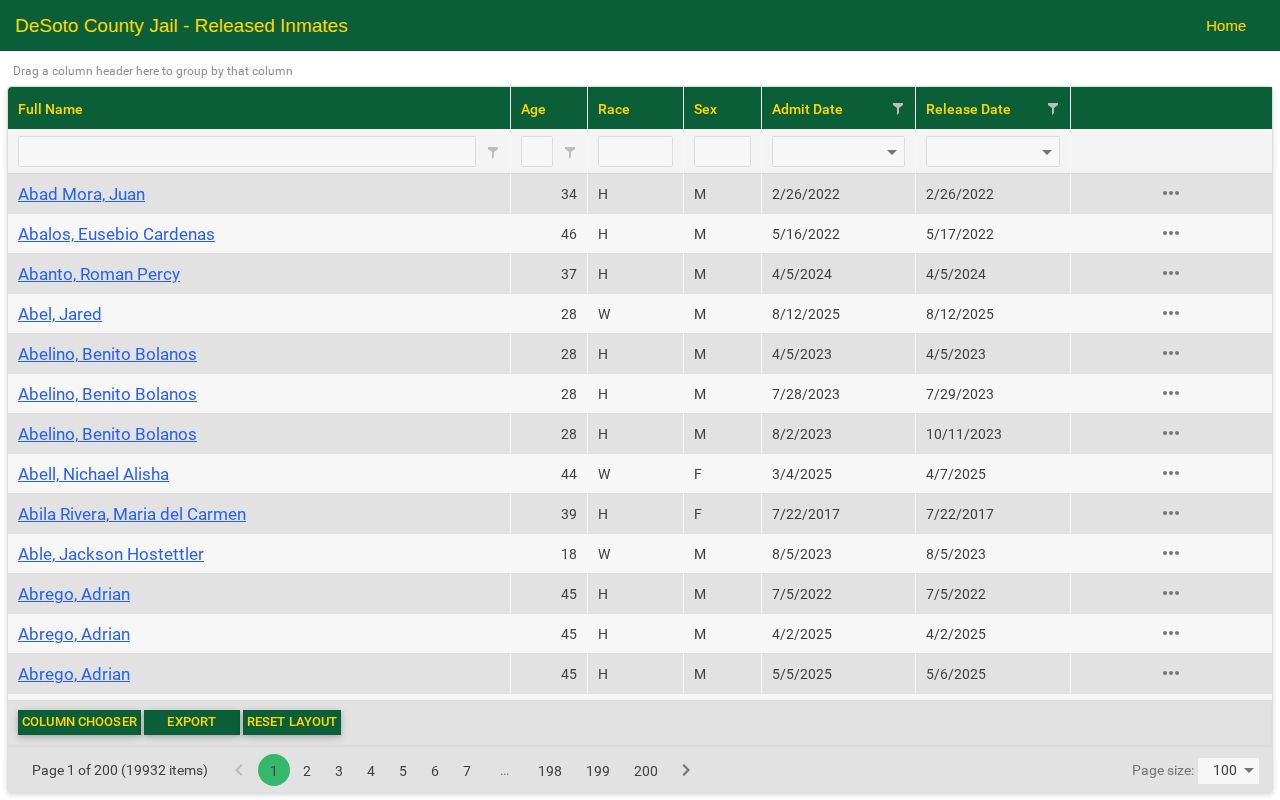
The column layout helps match the right stay before opening its detail. A records request remains the stronger route when an older entry is missing.
Request DeSoto Release Records
Florida public records are governed by Chapter 119 and the state constitution. DCSO accepts trackable requests through its JustFOIA public portal. Ask for the booking and release sheet, the recorded release date and type, and any public transfer destination. Include a booking photograph only when it is needed. A narrow request is easier to locate and price.
- Provide the person's full name, known aliases, and a reasonable booking-date range.
- Add the booking number or case number when known.
- Name the exact items requested, such as the release sheet, booking detail, or transfer notation.
- Choose electronic delivery where practical and ask for a fee estimate before broad work begins.
- Use the DeSoto Clerk when a certified judgment, sentence, bond order, or release order is needed.
DCSO Records & Warrants can be reached through 863-993-4700 or 863-993-4710, option 2 or extension 2626. Jail and booking use option 4 or extension 2630. Inspection guidance lists reasonable hours of 8:00 a.m. to 5:00 p.m. Florida law allows ordinary copy charges and a reasonable special-service charge when a broad request needs extensive staff or technology work. The office should provide an estimate.
Record limits: Victim details, juvenile information, medical data, protected addresses, active-investigation material, and sealed or expunged records may be withheld or redacted.
DeSoto Custody Systems Differ
DeSoto County's 2020 emergency plan reported an average DCSO jail population of 146 and a general capacity of 1,453 at the state correctional institution. These are dated planning figures, not current counts or annual release totals. They still show why a name found in Arcadia may belong to a local booking or to a far larger state prison population.
A live release search must still begin with the right custodian. The figures cannot show who is now held, released, transferred, or civilly committed.
When DeSoto Jail Releases Finish
DCSO does not promise a fixed release hour. Its Inmate Services guidance says release times vary and recommends allowing about an hour of processing before calling about a scheduled release. People waiting may use the jail parking lot on the south side of the building. The court order or bond payment starts the jail's work; it is not the same as physical departure.
For a time-sensitive check, watch the official Released record and call jail or booking if the entry has not appeared after processing. Use careful wording until it does. “Release ordered” describes the court event. “Released from DCSO custody” describes the sheriff's completed record. “Returned to the community” should be used only when no transfer or hold is shown.
DeSoto Bond Release Confirmation
Cash and surety bonds may be posted through the jail lobby on the east side of the Sheriff's Office. DCSO publishes bond amounts through its inmate search and by telephone. A successful payment begins the release process, but staff must still verify authority, complete records, check holds, and return property. The Released detail is the public marker that the booking ended.
The DCSO release-processing source shows where bond is posted and why timing can vary.
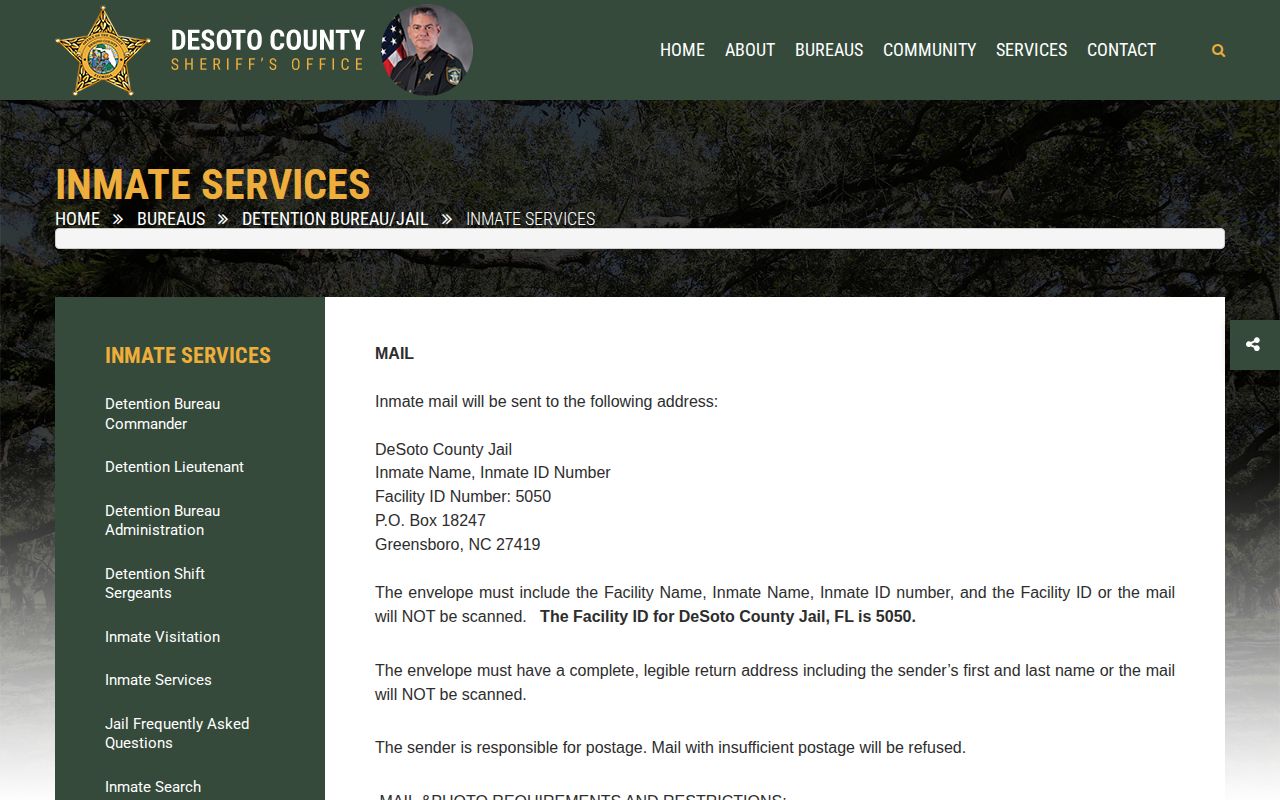
Compare that operational guidance with the court docket. A bond entry can coexist with another case, detainer, or transfer order.
Property After DeSoto Release
DCSO uses a Property Release Form for pickup before release, and the person collecting items must show identification. Property not collected beforehand ordinarily leaves with the released person. If items remain, DCSO describes notice, claim, abandonment, and disposal under Florida § 705.103. These steps are separate from proving release.
A commissary order that arrives after release has its own rule. DCSO gives the released person 30 days to retrieve it before donation. Call the jail classifications or booking channel about property status rather than using the released archive, which tracks custody events rather than stored items. This local rule is useful when reconnecting with someone after departure.
Note: Property pickup status neither confirms nor delays the legal release entry; ask DCSO about each matter through the proper channel.
Find DeSoto County Releases
Start by identifying the system that last held the person. A DeSoto arrest or short local sentence starts with DCSO. A state prison term starts with FDC. A federal sentence belongs in the Bureau of Prisons locator. Civil commitment at FCCC requires a court and registry check. Searching the wrong roster can produce a clean result that says nothing about the right agency.
- Choose Released in the DCSO inmate portal for a county jail booking.
- Match name, age, admit date, charge context, and arresting agency, then open the detail.
- Check Current for a new booking, but never treat absence as proof of freedom.
- Read the DeSoto Clerk docket for the disposition or custody order.
- Search FDC supervision or the destination system when transfer, probation, parole, or a hold is possible.
- Use VINE for alerts and request an archival record if the online trail is incomplete.
Why the roster changes: a person normally leaves the Current side when that DCSO booking ends. The Released side, court docket, and destination system provide the proof.
The DeSoto County 24-Hour Releases page focuses on the official one-day view. A named-person search can also use a longer day range in the same DCSO tool.
DeSoto FDC Release Search
The Florida Department of Corrections Offender Search separates current inmates, released inmates, supervised people, absconders, fugitives, and other records. For a former state prisoner, choose Inmate Release Information and search the six-character DC number when known. A name search supports prefixes and aliases. Then compare identity, offense history, photograph, incarceration history, release details, and community supervision.
| Search field or choice | Use | Important limit |
|---|---|---|
| DC number | Most precise state identifier | Six-character FDC number, not a DCSO booking number |
| First and last name | Prefix search for possible matches | Common names require more checks |
| Search aliases | Finds names linked to the FDC record | An alias still needs identity confirmation |
| Database type | Separates current, released, supervised, or absconded status | Search All exposes fewer specialized fields |
| Photo controls | Shows or filters profiles with an image | A photograph alone is not proof of identity |
FDC says its dedicated release database is updated nightly. The current population and supervised population receive full weekly refreshes, with certain date and location changes updated nightly. The official FDC menu below makes those separate scopes visible.
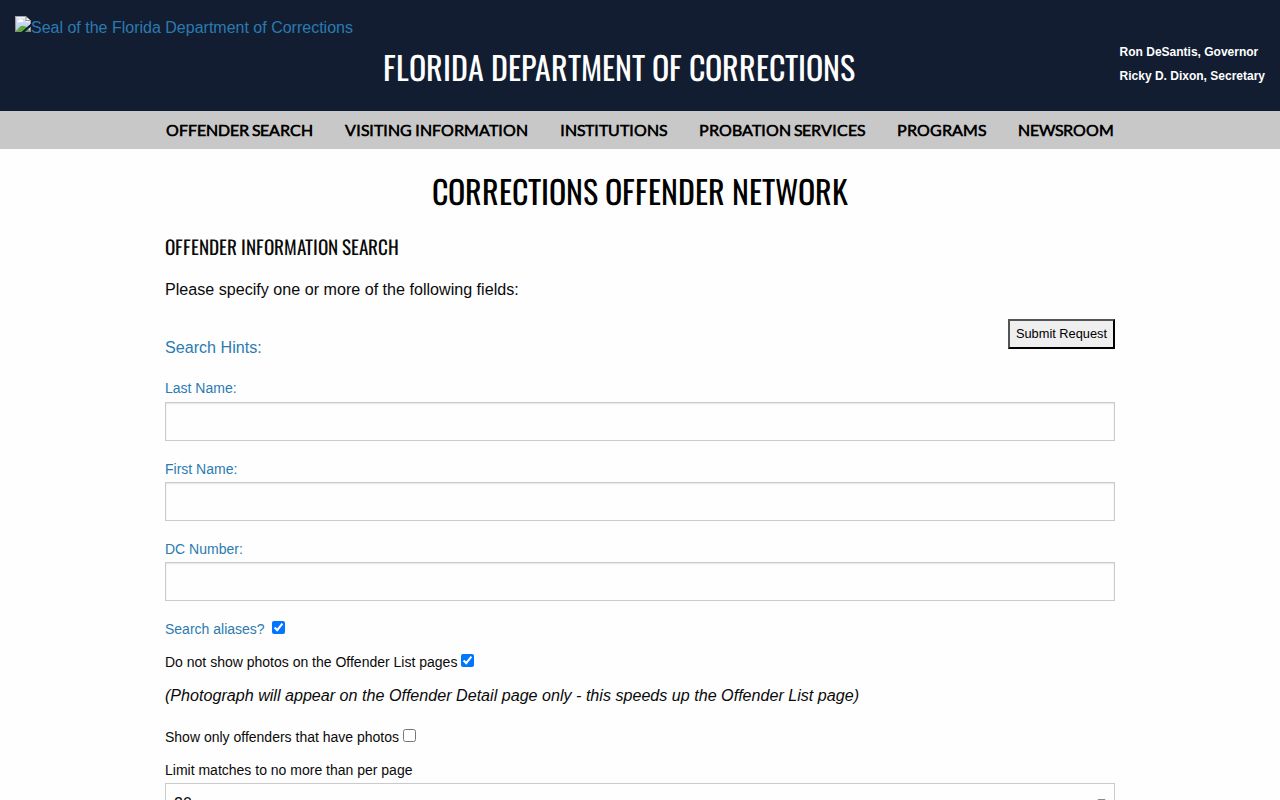
Read “Current Release Date” as a projection on an active record. An actual released record can list the date and release type, followed by any supervision history.
DeSoto Court Release Records
The DeSoto Clerk separates felony matters from misdemeanor and criminal-traffic cases, then sends public online searches to CiviTek county 14. Search by party name or case number. Open the correct criminal case and inspect its register of actions for a disposition, judgment and sentence, jail credit, time served, bond order, dismissal, probation, violation, commitment, or release order.
The official DeSoto criminal court portal is pictured below.
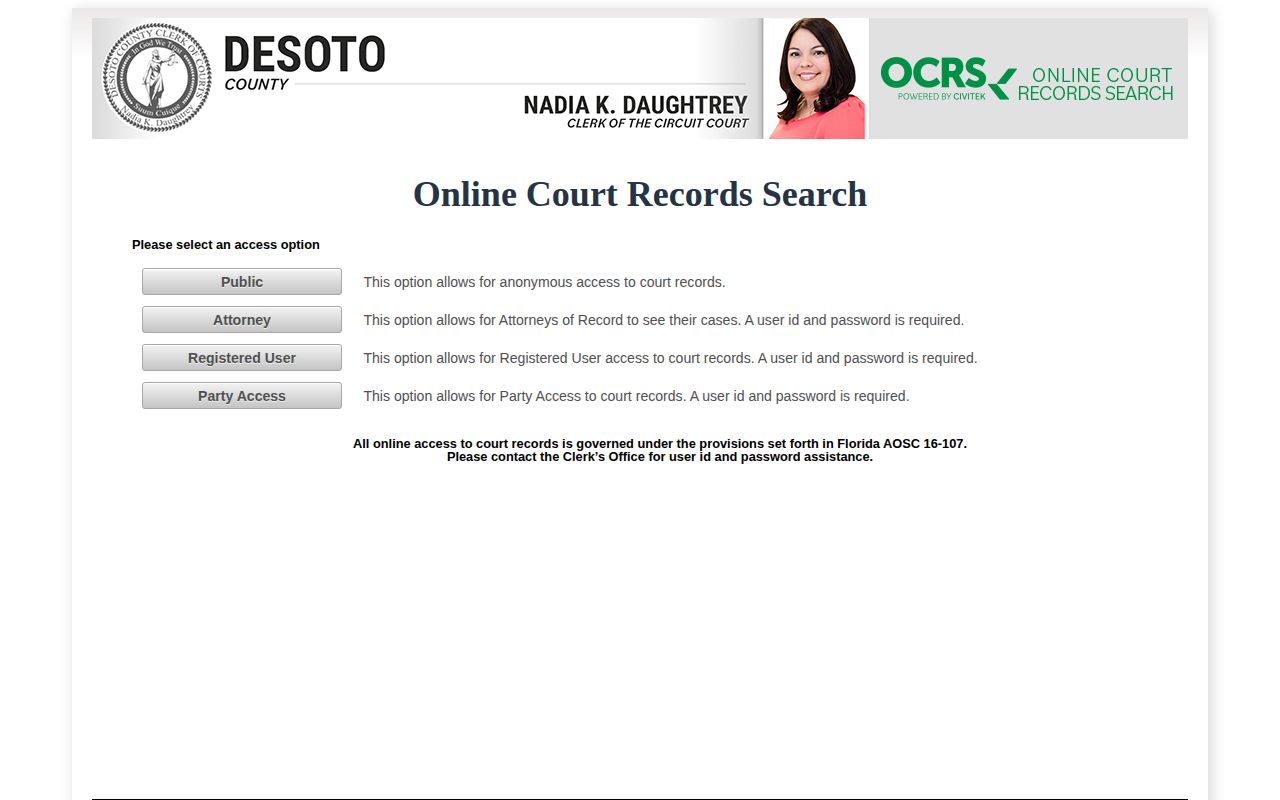
A docket can remain useful after a booking is no longer current. For authenticated proof, request a certified order from the Clerk at 115 E. Oak Street, Room 101, Arcadia. Sealed, expunged, juvenile, and confidential records may not be available publicly.
DeSoto Post-Release Supervision
Leaving custody and ending supervision are separate milestones. FDC Community Corrections supervises felony probation, community control, parole, conditional release, and related state statuses. Search the Supervised Population database by name or DC number and read the status, dates, supervision type, and office information. County-only probation may not appear there, so use the sentencing order and named local office when the FDC result is blank.
Florida Commission on Offender Review handles parole and some release decisions, mainly in older or special statutory cases. Most modern Florida prison cases do not have parole. The separate DeSoto post-release supervision resource explains the Arcadia office and absconder check.
DeSoto Release Into Civil Commitment
FCCC creates a local system boundary that many counties do not have. A person may complete an FDC prison term and then enter secure civil commitment in Arcadia under the Jimmy Ryce Act. The FDC criminal record may properly say released, yet the person has not returned to the community. That is a prison discharge followed by civil confinement.
Confirm a later FCCC community or conditional release through the civil-commitment court and, when applicable, the FDLE Sexual Offenders and Predators Search. DCF treatment records are confidential and are not a substitute for the court order. The registry has specific statuses, including confinement, civil commitment, supervision, and released subject to registration.
DeSoto Federal Release Checks
Florida VINELink can send notice about reported jail and FDC custody changes. It is a notification layer, not the final court record. For a federal sentence, use the BOP Inmate Locator, which can show a release date or “Not in BOP custody.” That wording proves only BOP status. U.S. Marshals detainees may be housed in contract facilities, so the federal court or relevant Marshals district may be needed.
The official BOP source below shows the federal route assigned to DeSoto County release research.
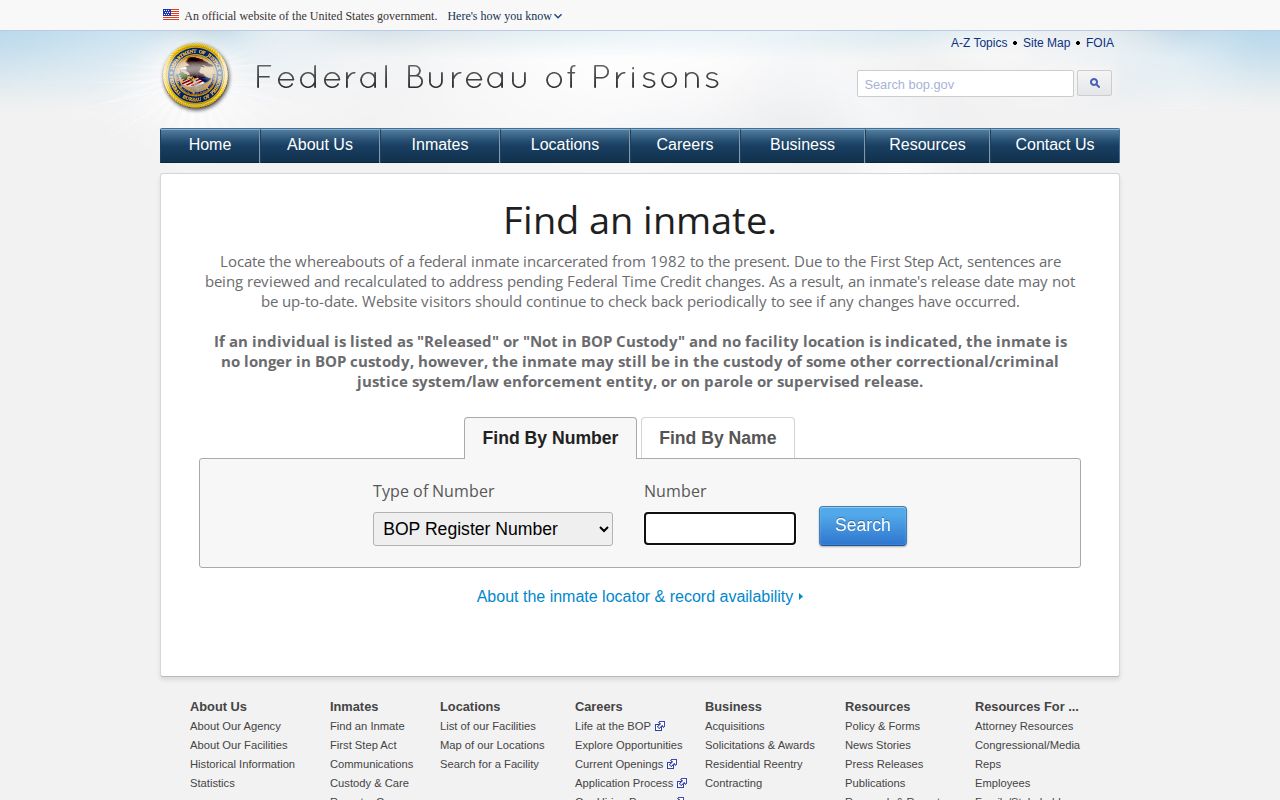
The ICE detainee locator is designed for current detention, not a full historical release ledger. DCSO also has a current 287(g) task-force agreement with ICE. If a DCSO record suggests an immigration transfer or detainer, check ICE and contact Enforcement and Removal Operations rather than calling the person free.
DeSoto Release Status Comparison
Each database answers a narrow custody question. Use the row that matches the last known facility, then follow any transfer clue.
- DCSO Current
- Shows an active DeSoto County Jail booking.
- DCSO Released
- Shows that the listed local booking ended, with admit and release dates.
- FDC Population or Release Information
- Shows state custody, a projected date, or actual prison release history.
- FDC Supervised Population
- Shows public supervision type, status, dates, and office information.
- BOP Inmate Locator
- Shows a federal prison release date or lack of BOP custody.
- Civil court and FDLE registry
- Show available judicial and registry status for civil commitment, not clinical details.
DeSoto County Release Facilities
Three distinct facilities shape local release searches. The DeSoto County Jail uses the DCSO Released database for county bookings. DeSoto Correctional Institution, its Annex, and Work Camp use FDC release and supervision records. The Florida Civil Commitment Center is a secure civil treatment facility, so release depends on a civil-court action rather than a jail roster.
- DeSoto County Jail: community release, bond, court order, sentence completion, or transfer may end the DCSO booking.
- DeSoto Correctional Institution / DeSoto Annex and Work Camp: an FDC location change may be a transfer, while release information and supervision history show a state discharge path.
- Florida Civil Commitment Center: leaving prison for FCCC is not community release; the civil court controls later release.
Always attach the agency name to the conclusion. “Released from DCSO,” “released from FDC,” and “released from FCCC” describe different legal and physical events.